
Doña Viviana’s Legacy of Oaxacan Beeswax Candles

In Teotitlán del Valle, Oaxaca, candlelight marks life’s most sacred moments — union, celebration, devotion. For centuries, traditional candle making has shaped these rituals, each flame carrying memory and meaning. At the center of this living craft is Doña Viviana Alávez, a master artisan preserving a 300-year legacy of handmade beeswax candles. Working exclusively by hand with pure beeswax, she pours each layer patiently, honoring a tradition that is both inherited and fiercely her own. Uncover her story of devotion — and the ceremonial marriage candles that have become a powerful symbol of love and commitment in her town.
THE Tradition OF Oaxacan Wedding Candles
In this Oaxacan pueblo, when a young man wishes to propose, he must first ask his beloved’s parents for her hand in marriage. But words alone are not enough. To prove his devotion, he arrives bearing a marriage candle — a monumental work of art built layer by hand-poured layer. Rising up to eight feet tall and formed through nearly 1,000 pours of beeswax, the candle burns for a year, marking the promise of union.


These offerings are made in a quiet home along a village street. Casa Viviana gives little hint of the ritual unfolding inside. Within its courtyard workshop, beeswax is melted, colored, poured, and cooled in a rhythm practiced for decades. It is here that Doña Viviana Alávez, now in her eighth decade, creates the towering wedding candles that have become a custom in her town.
Historically, ceremonial candles in Teotitlán del Valle were offerings, carried in processions and exchanged between families as symbols of faith and reconciliation. Though customs evolve, the symbolism remains. To light one is to mark a moment as sacred. Today, Viviana’s candles move between village ceremonies and modern celebrations, illuminating unions both intimate and communal.
Building Independence Through Craft
Viviana’s story began more than six decades ago. As a child, she learned beside her grandmother, using inherited wooden molds. From an early age, she absorbed the physical language of beeswax — how it behaves when heated, how color deepens with each pour, how patience shapes form.

But determined to set out on her own path from the candle-making tradition that had lived in her family for 300 years, she ran away at 14 and married a weaver. Years later, unsure of how to make a living, she sat beside a rose bush, absent-mindedly pulling petals from a flower.
In that quiet moment, she remembered her family and the craft she had left behind. And then, seemingly out of nowhere, she had her eureka moment: these layers of rose petals would make beautiful candles. She experimented with techniques. When she was satisfied, she placed her first ceremonial candles on the altar of the local church. It was the beginning of something entirely her own.
Hand-Poured Beeswax Candles, Layer by Layer
Each candle is formed through repetition. Melted beeswax is poured again and again over a woven cotton wick — sometimes close to one hundred layers for smaller pieces, and up to one thousand for the monumental wedding candles. During the process, candles hang suspended, forming wax stalactites as they cool and harden.
Each candle is built through repetition. Melted beeswax is poured again and again over a woven cotton wick — sometimes close to one hundred layers for smaller pieces, and up to one thousand for the monumental wedding candles. As they cool, the candles hang suspended, forming delicate wax stalactites before being shaped and refined by hand.
Viviana works exclusively with 100% beeswax from Chiapas, filling the town with the scent of honey most days of the year. Every piece is poured entirely by hand — no machinery, no shortcuts — just patience and practiced rhythm.
Color, too, comes from the natural world. Red is dyed with cochineal, green with local herbs, while white is achieved by sun-bleaching the beeswax itself. Some variations are gently scented with cinnamon, vanilla, or florals, adding another quiet sensory layer to the experience of flame.
At 75, Viviana still insists on finishing each candle herself. She believes they burn longer because of the attention she gives them, and that the wicks burn cleaner because of their quality. No candle leaves her workshop without her approval.
While the towering marriage candles are the showstoppers, she also creates tapers and sculpted roses — smaller forms that carry the same devotion to craft.

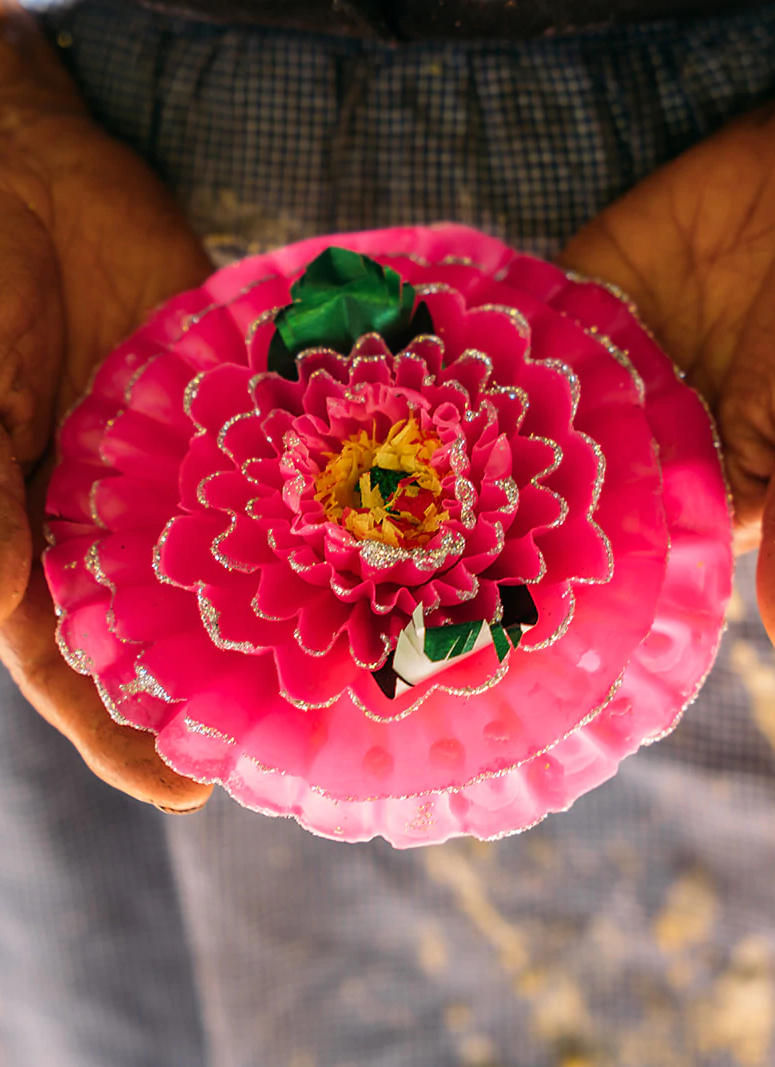

Centuries of Mexican Candle-Making Tradition
Her work made Viviana one of the most respected craftswomen in her region. Years later, she was featured in a magazine that found its way into her grandmother’s hands. They reconnected — and when they reunited, her grandmother wept, telling Viviana how proud she was. The craft she once left behind had led her back home.
As she prepares to pass her techniques to her sons, the knowledge held at Casa Viviana continues to move forward — shared, practiced, and preserved through making. At Obakki, we are honored to share the work of Casa Viviana — handcrafted beeswax candles shaped with devotion and respect for tradition.
These are objects created for union, celebration, and quiet ritual, formed by hands that understand the power of flame. These candles are proof that a craft passed down for centuries can pause, wander, and still return. And that sometimes, the flame you thought you left behind is the one that lights your way forward.
SHOP THE COLLECTION
Related Posts

The Art of Mezcal: Culture, Craft, and Tasting
Mezcal is a traditional Mexican agave spirit rooted in centuries of artisanal craft. Produced primarily in Oaxaca, it reflects a deep relationship between land, climate, and the maestros mezcaleros who oversee its small-batch distillation.

Meet the maker: Tanya Gabrielle
Tanya Gabrielle came to Tofino for a summer. Sixteen years later, she's still there. After years spent working in a demanding career in Vancouver, Tanya arrived on Vancouver Island drawn to surfing and a slower pace of life. What began as a temporary escape gradually became home, shaped by the vastness of the Pacific, the stillness of the inlet, and the ancient rainforest surrounding it.

Where Thread Becomes Architecture: Caralarga
Working alongside a collective of women artisans, Caralarga preserves traditional textile knowledge while reimagining it for contemporary interiors.